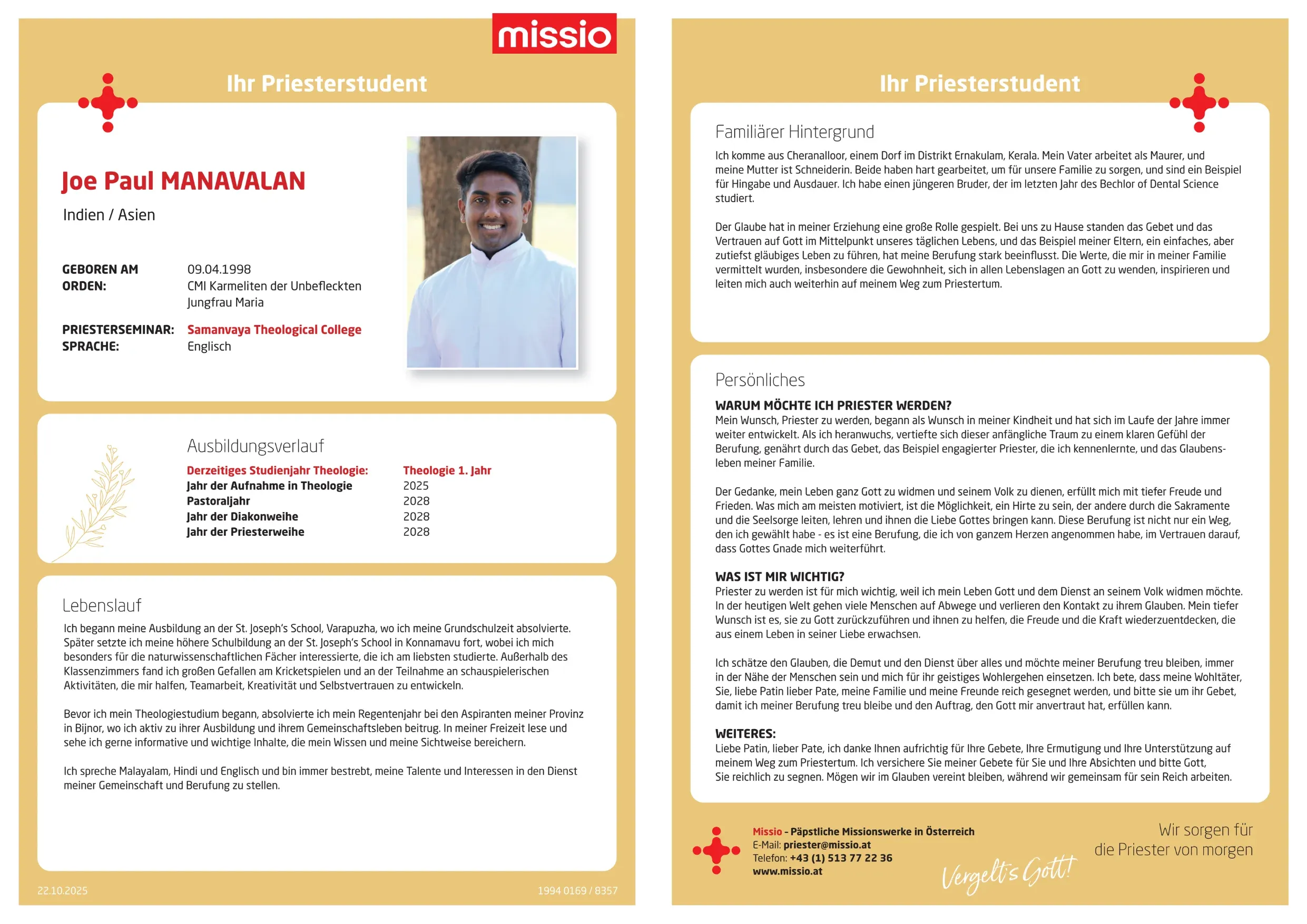
This section serves as a guide explaining how seminarians can register on our website and present themselves to the benefactors.
To be admitted to the Missio Austria priest sponsorship programme, every seminarian must register through our website. They can enter their personal data there themselves or via an authorised person. This data will be stored online and must be verified by the rector so that it can be transferred to Missio Austria. This registration is only required once. Afterwards, Missio Austria will look for a benefactor who will accompany the seminarians with prayer and financial support throughout their formation.
👉 Link to the website: https://www.missio.at/seminarian/
Step 1: Language
The seminarians have to select the language in which they should be introduced to the benefactor:

Step 2: Seminary
The seminarians should select their seminary from the list, together with the project number, which ensures that each seminarian can be clearly identified.
⚠️ ATTENTION: If the wrong seminary / project number is selected, the seminarian will be assigned to the wrong seminary and therefore receive the wrong support.
Step 3: Personal Data
The seminarians are required to provide their personal data:
- Surname as in passport (is automatically written in CAPITAL LETTERS)
- First name as in passport (only the first letter should be capitalized)
- Date of birth
- Diocese
- Religious order (optional field: can be left empty if he is a diocesan seminarian)
Further notes on this data:
- The seminarians should write out all names clearly to avoid any confusion. Due to cultural differences, there can be misunderstandings about the order of names. Any middle names should be added to the “First names” field. Surnames and first names should be entered separately. No titles should be included.
- The date of birth should always be entered. If the exact date is not known, a fictitious date with the correct year should be provided, such as 01/01/YYYY.
- Every student must enter a diocese. This should be either the diocese in which they were born or the diocese that sent them. The same applies to religious orders and international students.
- If the seminarian belongs to a religious order, the full name of the order should be entered without abbreviations. Prospective diocesan priests should leave this field blank.
Step 4: Periods of Study
Please indicate the period of studies:
- Registration usually takes place upon entry into Theology 1. If the seminarian joins the seminary or the sponsorship program while already in Theology 2, 3 or 4, the current year of theology should be selected. Deacons and seminarians in pastoral ministry who are no longer at the seminary cannot be presented.
- The year of admission should be entered, along with the expected pastoral year and the planned years of diaconal and priestly ordination. The year of admission refers to the year in which studies at the theological seminary began.
Step 5: Description
This is a vital part of each seminarian’s presentation to their future benefactors. Each presentation must be personal and honest. This section is intended to help benefactors build a personal relationship with the seminarian while supporting them financially and spiritually throughout their four years at the seminary.
We believe that each young person on the path to the priesthood is unique. Therefore, it is important that the seminarian shares their personal story and journey. This should be done honestly and openly, without copying from others.
The questions added to each section should help the students to do this.
⚠️ ATTENTION: For data protection reasons, full first and last names should not be used; only first names should be provided.
Curriculum vitae (Between 150 and 220 words)
The seminarian should write their life story in the form of a short narrative, using complete sentences. A simple list of dates and years is not sufficient. The following questions may serve as guidance: Which schools were attended? Which subjects were particularly enjoyed? What contributions were made to the home church? Where did the seminarian live before beginning theological studies? How is free time spent? What hobbies are pursued? Which languages are spoken?
Family background (Between 100 and 150 words)
The following questions may serve as guidance: Where is the seminarian from? What do the parents do for a living, and how has this influenced the seminarian? How many siblings are there? How was faith practiced within the family, and how did this influence the seminarian’s vocation at a young age?
Why do I want to become a priest? (Between 80 and 150 words)
The following questions may serve as guidance: What inspired the seminarian to pursue the priesthood? Was there a particular event that played a significant role in this vocation? This information is very important, as a meaningful testimony can help benefactors better understand why young men choose to become priests and why it is important to pray for them.
What is important to me? (Between 80 and 150 words)
This section offers the seminarian the opportunity to share personal hopes for their family, their country, and their future ministry. Prayer intentions may also be included. Seminarians are encouraged to speak openly about their future dreams and aspirations. Together with the testimony of their vocation, this helps to build a meaningful connection between benefactors and seminarians, enabling benefactors to support them concretely through prayer.
Remarks
This section may be used to share any additional thoughts. For example, the seminarian may express the intention to pray for the benefactor or share specific prayer intentions.
➡️ The individual testimonies of each young man aspiring to become a priest help us at Missio and the benefactors to see the work of God in the world. This gives us hope. Sharing these testimonies is a powerful inspiration and motivation, encouraging support of priestly formation. Europe needs these testimonies now more than ever. We need to use them to evangelize the country anew.
Step 6: Photo
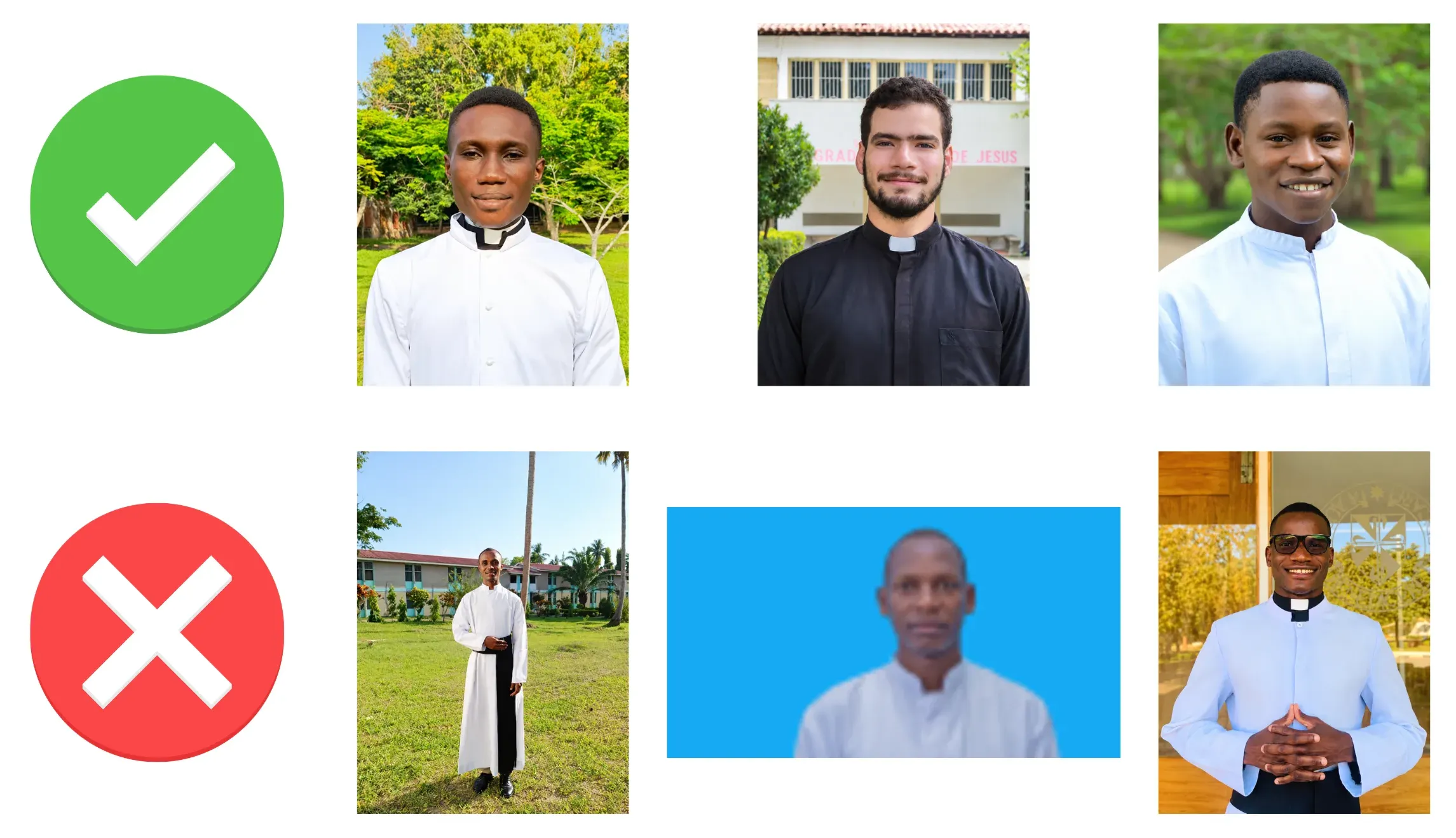
The photo is particularly important in forming a benefactor’s first impression of a student. The following guidelines must be followed:
- The photo should be a portrait and pre-cropped (format 2:3 or 3:4)
- Ideally, the student should wear a cassock
- Students should not wear sunglasses
- It should not be a selfie
- The student should have a friendly smile
- The background should be natural (e.g. outdoors in nature), no digitally created or edited backgrounds
- The photo should be of good quality (HD)
- Do not reduce the file size if it is already smaller than 2MB
- Allowed file formats: JPG, PNG, BMP, WEBP, HEIC, HEIF (no PDF !!!)
Here are some examples:
Step 7: Sending Data to the Rector
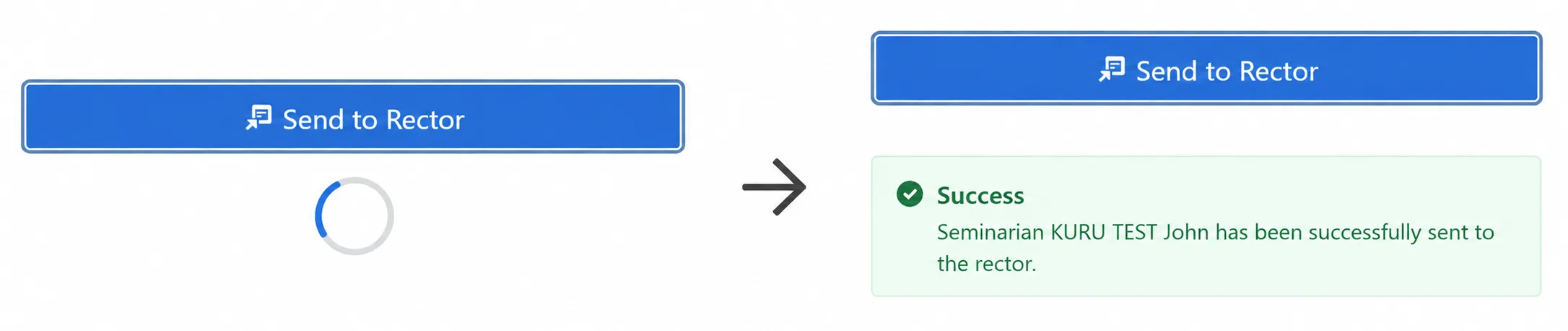
Once the seminarian has entered all his details, he can send his data to the rector. After pressing the button, he must wait for the green confirmation. The form will then clear itself. The rector can then log in and proceed with checking the seminarian.
Finally: What the Benefactors Receive
Once a seminarian’s registration is complete and a benefactor has been found, Missio prepares a data sheet with his personal details and photo. This sheet is then shared with the benefactor so that he can get to know the seminarian he supports. It is therefore very important that the registration is done well, carefully, honestly, and with attention to detail, as the personal presentation of the seminarians is essential for building a meaningful and personal connection.